From Postcards to Pocket Cameras: The Changing Travel Souvenir
The changing travel souvenir is less about what fits in a suitcase than what brings a place back: choose keepsakes with texture, context, and meaning.
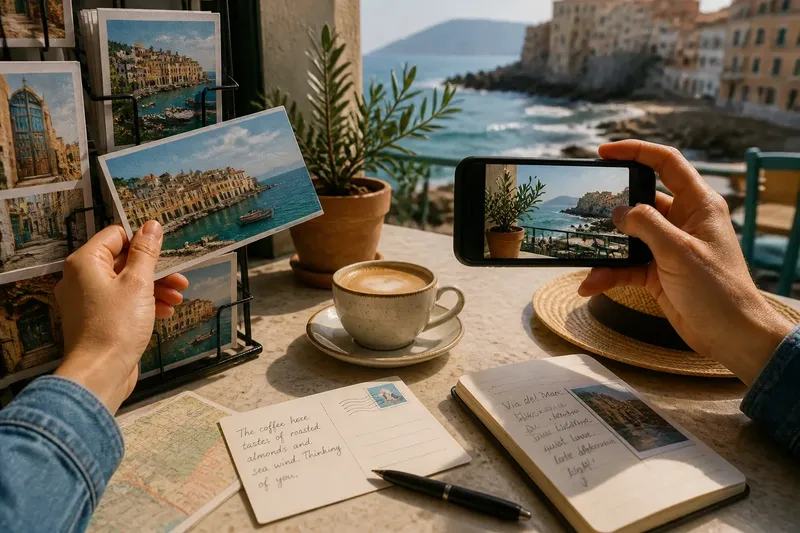
At a seaside café, a traveler slides a postcard from its rack, then raises a phone toward the same view. The changing travel souvenir is right there: one keepsake offers a printed image and space for handwriting; the other can preserve a private record of light, sound, and passing details.
Neither choice has to win. A good souvenir is a trace that helps a particular place return to mind, whether it was bought, collected, photographed, or simply noticed. These six approaches can help you bring home something that still feels connected to the trip.
What does a postcard hold that a camera roll cannot?
A postcard is a picture with a border, a back, and a place in the physical world. Its limited space asks you to select one view, then attach a short note to someone—or to your future self. The handwriting, stamp, and slight bend in a corner become part of the object’s story.
Printed cards also show how a destination chooses to represent itself. A rack might favor a famous harbor, an ornate doorway, or a cartoon version of local life. That image may be polished or predictable, but it can reveal which scenes are presented as symbols of the place.
Try writing a detail that the printed front leaves out: the smell of coffee, the wind lifting a tablecloth, or the name of a street you wandered down. Keep the message specific enough to reopen a moment rather than merely announce that you were there.
Choose a postcard when you want a small, handled record with a deliberate frame.
How do postcards and pocket cameras preserve different travel memories?
This comparison is about keepsake options, not a claim that one replaced the other across all travelers or destinations. A postcard offers a selected, printed view; a camera lets you make an image of a detail or moment that matters to you.
With pocket cameras and phone cameras, picture-making can happen quickly. You might photograph a painted sign, a friend’s expression, market colors, or late light crossing a station platform. These images are personal, though a large camera roll can make individual pictures easy to overlook.
The formats can sit side by side: a paper ticket beside a digital photograph, or a handmade bowl linked to the conversation that led to its purchase. An object offers material presence; an image can preserve a fleeting arrangement.
Think of the camera as another collecting tool, not a requirement to record everything.
Which small details make a memory return?
A landmark can identify where a photograph was taken, but a modest detail often carries more of the feeling. A menu with a handwritten special, a tiled wall, a ferry’s painted railing, or the creased map used to find a bakery can anchor a memory in the texture of an ordinary day.
Notice what caught your attention before you reached for a souvenir. Was it a sound, a material, a local custom, or the way a familiar object looked in an unfamiliar setting? That first flicker of interest may be a stronger guide than the most prominent gift-shop display.
Say you spend an afternoon in an invented hill town and keep noticing blue shutters against pale stone. You photograph one doorway, jot the lane’s name in a notebook, and skip a decorative magnet; the image and note give you a specific color and location to recall, while you avoid carrying home an object with no personal connection.
Keep a short caption with a photograph when the detail’s context might otherwise fade.
What makes a travel souvenir feel worth bringing home?
A worthwhile keepsake does not need to be rare or expensive. It may earn its place because it was made nearby, serves a purpose, or connects to a moment you would like to remember. A useful object, such as a small ceramic cup, can bring a place into ordinary routines without pretending to represent the whole destination.
Consider the object’s story as well as its appearance. Who made it, what materials does it use, and can the seller explain its local connection? An answer may help distinguish a locally made craft from a souvenir that only borrows the look of a place.
Give the journey home some thought, too. A fragile or awkward item may demand more care than the pleasure it offers, while a flat print, fabric patch, or recipe card can be easier to keep. The right choice depends on what you will genuinely use, display, or revisit.
- Check whether the object recalls a specific encounter; if it does, consider keeping it, and if not, leave it behind or choose a more personal reminder.
- Check whether you can name where it came from and what drew you to it; if you can, keep that detail with it, and if you cannot, ask the seller or reconsider the purchase.
- Check whether you will enjoy seeing or using it after the trip; if yes, choose a place for it at home, and if no, take a photograph or make a note instead.
- Check whether it can travel home without undue fuss; if it can, pack it appropriately, and if not, choose a flatter or sturdier keepsake.
- Check whether the material or making has a clear connection to the place; if it does, record what you learn, and if not, avoid treating its appearance alone as proof of local origin.
- Check whether the item needs special care you are willing to provide; if you are, plan how to carry it, and if not, choose a less delicate reminder.
Let a clear connection, rather than a souvenir shelf’s abundance, make the decision.
How can you collect images without turning the trip into a photo hunt?
Photographs work best as souvenirs when they leave room for attention. Before taking a picture, look at the scene without a screen: notice its edges, the movement within it, and what is happening just outside the obvious view. Then decide whether a photograph would help you remember it, or whether the moment is better kept unrecorded.
A few varied images can make a more useful record than a long run of near-identical views. You might keep one wide scene for orientation, one close detail for texture, and one candid frame of the people you are traveling with. The point is to notice whether the pictures tell you something different from one another.
Captions are a simple bridge between an image and its context. Add the neighborhood, the name of a dish, or a note about why you stopped. Without that small clue, a photograph of a doorway or cup may look lovely later while leaving you unable to place it.
When taking photos of people, be attentive to their comfort and ask permission when the situation calls for it. A souvenir should not depend on making someone else feel watched or exposed.
What can you keep when the best souvenir is not for sale?
Some travel memories have no useful object attached to them: the rhythm of a street musician’s tune, warm bread wrapped in paper, or the route back to a guesthouse after a long afternoon. You can preserve these impressions with a brief note, a voice memo recorded later, or a sketch made from memory.
Writing immediately can help, but it need not become a daily diary. Record one sharp detail while it is still clear: a phrase you heard, the weather at a particular corner, or the unexpected kindness that changed the mood of an errand. A few exact words may do more than a page of general praise.
Imagine returning from an invented market town with no purchase that feels right. You write down a vendor’s description of a local pear, sketch the striped awning, and save a photograph of fruit piled in a wooden crate; the note, drawing, and image preserve the encounter without turning it into a shopping task.
For the changing travel souvenir, ask what can bring this particular place back to you. A postcard, camera image, useful craft, or carefully noted impression can all do the job. Before leaving, add a small clue—where it came from, who was there, or what caught your eye—so the keepsake’s story stays attached to it.
Which questions help you choose the right kind of keepsake?
Is a postcard better than a travel photo?
A postcard gives you a printed view and a physical space for a message, while a travel photo can capture a personal detail the card rack may not show. Choose the one that preserves the part of the moment you want to revisit; you can also keep both if each adds something distinct.
How do I remember where a travel photo was taken?
Add a short caption with a neighborhood, street name, dish, or reason you stopped. If you do not know the exact location, record the nearest landmark or another detail you can identify rather than guessing.
What is a meaningful souvenir if I do not want to shop?
Keep a brief note, a sketch, a voice memo, or a photograph of a detail that caught your attention. Pair it with a location or a few words about the moment so the memory has context later.
How can I tell whether a souvenir is locally made?
Ask the seller who made it and where the materials or production come from, then consider whether the answer is clear. If you cannot confirm a local connection, enjoy the object for what it is without assuming its appearance proves its origin.